Acuarela Bistro is considered one of the most popular spots in Bucharest. Located on Polona Street at number 40, Acuarela Bistro is closely related to two other establishments: Acuarela Bufet and Plastilina.
Acuarela Bistro is among the most popular spots in Bucharest. Located on Polona Street at number 40, Acuarela Bistro is a close relative of two other establishments: Acuarela Bufet and Plastilina. Acuarela boasts a familiar atmosphere where the decor is made up of details that give the place a unique, unmistakable character.
Alexu Toader, one of the owners of this establishment, agreed to share some information about the creation of Acuarela, as well as other details that shape its story.
What is the concept of the Acuarela venue?
Acuarela is a small family-run social enterprise that has involved the whole family from the beginning: myself, my brother Andrei, and our parents, Dan and Aura Toader.
A vibrant mix of nostalgic reconditioned objects and artworks collected over the last five years, Acuarela is a space designed by the brand engagement agency Hello Menthol (a branding agency we created in 2008), together with a large group of friends and artists.
Acuarela was initially conceived as a café for a small group of artists, an informal platform for connection between artists, curators and their audience, and a generator of traffic and funding for exhibitions at Imbold, Galeria.
How long did the landscaping work take?
I rented the house in Polona in September-October 2012 and inaugurated Imbold, Galeria after 3 months, at the end of December, as the first project of the newly founded Imbold Association.
After another three months, we also opened Acuarela, which was initially a café with a very limited menu intended for the artists we worked with and a small community of friends and friends of friends.
At Acuarela, we can speak of an initial setup that lasted approximately 4 months and in which the contribution of friends was overwhelming; then we can talk about a concept that implies constant redecoration, in which monthly, for almost 3 years we replaced furniture pieces, opened and later extended the terrace, closed the gallery with temporary installations or with the Artmaroc art shop, modified the lighting, acoustics, and atmosphere.
What materials did you use?
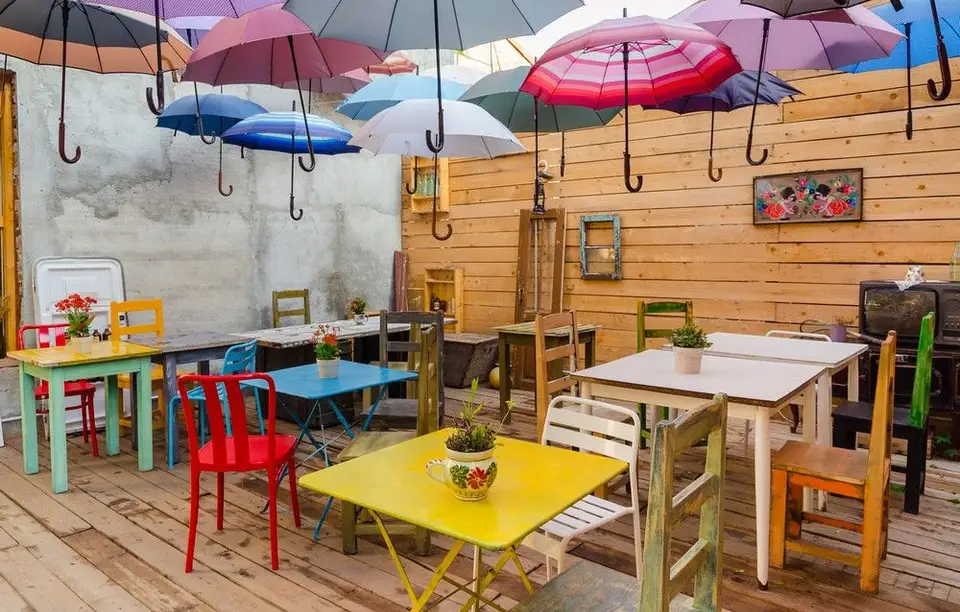
To create the intimate attic atmosphere, we used a lot of wood, much of it recycled; we used water-based paint, acrylics and mosaic, paper for lamps, and plenty of white canvas to give an airy, clean and bright tone nonetheless.
I used gypsum board for the gallery area and insulation for the portion where we host jazz concerts. In the non-smoking area, I cleaned and matte-lacquered the brickwork and refinished the thick plank flooring.
Where did you purchase the furniture and other decorative elements?
I created a mix between furniture pieces from the family dowry and recycled old furniture from the former Counting Crows hostel, along with furniture pieces from the exhibition organized by Andrei Argaetic for the 2011 White Night of Galleries and various objects salvaged from abandoned or demolished factories and workshops.
Some chairs are purchased from Sighetul Marmatiei, others are recycled with the help of friends from the Woodyo workshop and painted patina to fit the decor. Others are new and have been painted as part of a friend mobilization project: Friendly painting, where everyone has their own chair painted at Acuarela.
Have you encountered any technical issues during your work?
The biggest challenge of the renovation was winter. I stored a lot of things in the yard, and the operation was not easy at all. Another problem were the contractual limitations set by the property owners; we couldn't modify certain sections and finishes, such as the joinery, the glossy ceramic floor, and the staircase to the attic.
In the end, perhaps these limitations forced us to be more creative. For example, we minimally modified the bathrooms, dressing the bathtub in wood and masking it with a library full of colorful nostalgic objects, a bathroom that was voted the most beautiful bathroom in Bucharest venues in 2011.
What is the total area of the project?
The interior area is 100.2 square meters, while the courtyard is almost 500 square meters.
Can you tell us what the estimated budget was?
The initial investment in Acuarela was €25,000 in the first phase of renovations (autumn-winter 2012), followed by another €12,000 in the spring when we purchased the busbar and built the stages and space partitioning.
In 2014, we refurbished or replaced a large part of the furniture, extended the bar, replaced a significant portion of the bar equipment, and redesigned the back garden (approximately €15,000).
The idea of a living space in constant change is a very important aspect of Acuarela's positioning. In addition, Acuarela also includes a mobile event kit consisting of 3 cars from the 60s-70s and a retro caravan with which we participated in several events last year.
The estimated budget for their purchase and event furniture was approximately €10,000, to which are added repair and maintenance costs.
How would you describe the style of the interior design?
Acuarela is a colorful blend of nostalgia and artsy works, an intimate French bistro and Romanian improvisation.
What influences did you have?
Hello Menthol conceived the design of Acuarela space by recycling objects and works collected over time or from previous projects, from antique fairs and donations from friends. Although they are from different registers, the objects are put into a unitary context and, according to some opinions, give a watercolor-like appearance.
We weren't inspired for the interior design so much as we were constrained by the collection we started with and the limitations imposed by the house owners.
We really liked the idea of colorful umbrellas hanging with a transparent thread, an idea taken from a town in Portugal with a street decorated in this way, and we used it in the terrace design to replace the conventional umbrella with a stand.
Acuarela is a colorful bistro for Bucharest's creative community, a social hub, a jazz promoter, a warm host of theater performances and performances.
Did you ask an architect for their opinion before starting the design?
A large number of friends and friends of friends contributed to the creation of Acuarela; however, the unity and coherence of the concept were due to the involvement of our family. We didn't hire a specific architect for the design, but we were lucky enough to have opinions from architect friends.
How would you describe the people who frequent Acuarela?
Initially, our audience was almost exclusively from the marketing, advertising, visual arts and entrepreneurship fields. As the place's notoriety grew, so did the audience. We like to believe that it is a relaxing place for people who have something to say in the city. In addition to tourists, we also have a set of customers who come out of curiosity, like to a museum.
If you decide to stop by Acuarela Bistro, you're sure to discover something you'll like, an old object that will awaken nostalgia related to your grandparents' house or childhood, so don't hesitate to pay it a visit.
We can say that Acuarela Bistro is one of the most popular places in Bucharest. Located on Polona Street at number 40, Acuarela Bistro is a close relative of two other restaurants: Acuarela Buffet and Plastilina. At Acuarela, a familiar atmosphere prevails, where the decor is made up of details that give the place a unique, unmistakable imprint.
Alexu Toader, one of the owners of this establishment, agreed to share some information about how Acuarela came into being, as well as other details that would outline its story.
Acuarela is a small family social business in which the whole family was involved from the beginning: me, my brother Andrei and our parents, Dan and Aura Toader.
A colorful mix of nostalgic reconditioned objects and works of art collected over the last 5 years, Acuarela is an arrangement by the Hello Menthol brand engagement agency (a branding agency created by us in 2008) together with a large group of friends and artists.
Acuarela was initially conceived as a cafe for a small group of artists, an informal platform for connection between artists, curators and their audience, and a generator of traffic and funding for exhibitions at Imbold, Galeria.
We rented the house on Polona Street in September-October 2012 and inaugurated Imbold, Galeria after 3 months, at the end of December, as the first project of the newly established Imbold Association.
After another 3 months we opened Acuarela, which was initially a cafe with a very limited menu, initially intended for the artists we worked with and a small community made up of friends and friends of friends.
At Acuarela, we can talk about an initial arrangement that lasted approximately 4 months and in which the contribution of friends was overwhelming; then we can talk about a concept that implies constant redecoration, in which monthly, for almost 3 years, we replaced furniture pieces, opened and later expanded the terrace, closed the gallery with temporary installations or with the Artmaroc art shop, modified the lighting, acoustics and atmosphere.
We made a mix between furniture items from the family dowry with old recycled furniture from the former Counting Crows hostel, furniture pieces from the Ebenist Maler exhibition organized by Andrei Argaetic at the 2011 Night of Galleries and various objects salvaged from abandoned or demolished factories and workshops.
Some of the chairs are purchased from Sighetu Marmației and others are recycled with the help of friends from the Woodyo workshop and painted patinated to fit into the decor. Others are new and have been painted as part of a friend mobilization project: Friendly painting, where everyone has their own chair painted at Acuarela.
I think the biggest challenge of the arrangement was winter. We stored a lot of things in the yard, and the operation was not easy at all. Another problem were the contractual limitations set by the building owners; we couldn't modify certain portions and finishes, such as the carpentry, the glossy ceramic floor, the staircase to the attic.
The initial investment in Acuarela was 25,000 euros in the first phase of the arrangements (autumn-winter 2012), followed by another 12,000 euros in the spring, when we purchased the bus-bar and built the stages and compartmentalization of the spaces.
In 2014 we redid or replaced a large part of the furniture, extended the bar, replaced a significant portion of the bar equipment and redecorated the backyard (approximately 15,000 euros). The idea of a living space, constantly changing is a very important aspect of Acuarela's positioning.
In addition, Acuarela also includes a mobile event kit consisting of 3 cars from the 60s-70s and a retro caravan with which we participated in several events last year. The estimated budget for their purchase and event furniture was approximately
Acuarela is a colorful blend of nostalgia and artsy works, an intimate French bistro and Romanian improvisation.
Hello Menthol conceived the space design for Acuarela by recycling objects and works collected over time or from previous projects, sourced from antique fairs and donations from friends. Although from different registers, the objects are placed in a unitary context and, according to some opinions, give a watercolor-like aspect.
We were not inspired for the interior design but rather constrained by the collection we started with and the limitations imposed by the house owners.
Acuarela is a colorful bistro for Bucharest's creative community, a social hub, a jazz promoter, and a warm host for theater performances and performances.
Many friends and friends of friends contributed to the creation of Acuarela; however, the unity and coherence of the concept were due to our family's involvement. We did not hire a specialized architect for the design, but we were lucky to have opinions from architect friends.
In the end, perhaps these limitations forced us to be more creative. For example, we minimally modified the bathrooms, dressing the bathtub in wood and masking it with a library full of colorful nostalgic objects, a bathroom that was voted in 2011 as the most beautiful bathroom in Bucharest's venues.
Initially, our audience was almost exclusively from the marketing, advertising, visual arts, and entrepreneurship fields. As the place gained notoriety, the audience has expanded. We like to believe it is a relaxing place for people who have something to say in the city. We also have a set of clients who come out of curiosity, like to a museum, besides tourists.