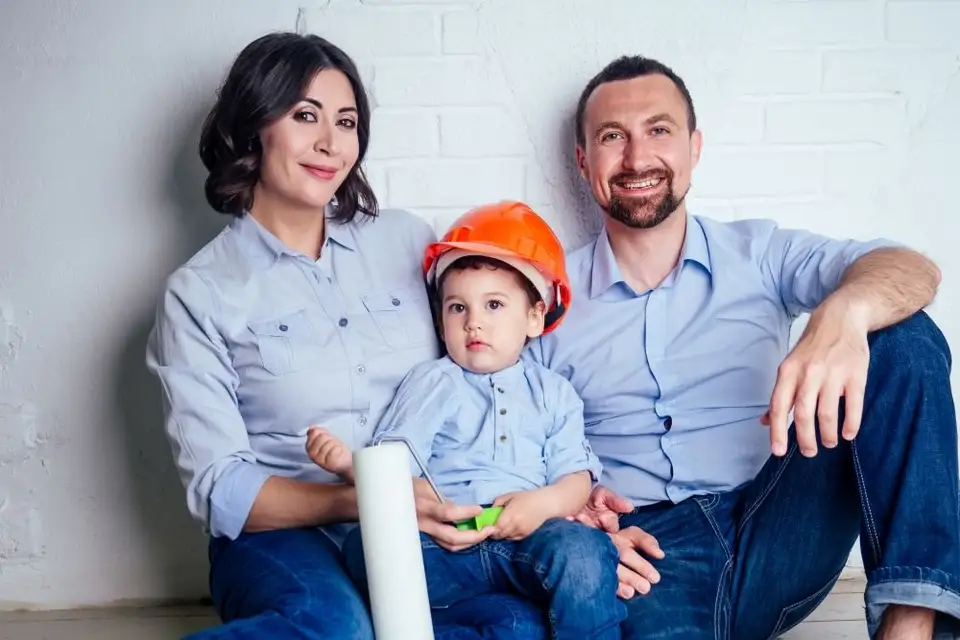
happy family handsome man in helmet hardhat and charming woman and their cute little son sitting on the floor against a white wall . concept of repairs house apartment by young family.
We know that our children spend an average of 7 hours a day in front of screens, according to the Common Sense Media study from 2024. Finding activities that engage them physically and mentally becomes a real challenge for parents. And yet, there's something magical in the simplicity of a box full of pieces waiting to come to life: construction sets.
It's not just about parental or grandparental nostalgia. It's about something much deeper: the unique ability of these toys to create authentic bridges between generations, to transform free time into a learning experience, and to offer a welcome break from "digital agitation.
Why we build more than just models
Maria, a mother of two from Bucharest, remembers with emotion: "The first time I built something together with Andrei, he was 6 years old. Now he's 14 and we still keep that little house on the shelf. Not because it's perfect - it has flaws too - but because it reminds us of those afternoons spent together, laughing at our mistakes.
Such stories are not isolated. Research from the University of Cambridge shows that children who spend at least 30 minutes a week in structured manual activities with their parents develop 40% more problem-solving skills than those who don't.
The scientifically proven benefits of construction
For children: a complete gymnastics for the mind
Recent neurological studies, published in the Journal of Cognitive Development (2024), highlight fascinating data:
Spatial development: Children who regularly work with construction sets improve their visuospatial abilities by 32%, essential for mathematics, science, and technology.
Executive functions: The construction process activates the prefrontal cortex, improving planning, organization, and self-control.
Creativity: 78% of children constantly exposed to building games develop divergent thinking - the ability to find multiple solutions to the same problem.
Dr. Elena Popescu, child development psychologist, explains: "When a child builds, they don't just connect pieces. They learn to predict, adjust, and persevere. Every small failure - a misplaced piece - becomes a valuable lesson in resilience.
For adults: therapy without a cabinet
Interestingly, construction sets have recently become a recognized form of occupational therapy for adults. A Lancet Psychiatry study from 2023 shows that manual repetitive activities, such as construction, reduce cortisol levels (the stress hormone) by up to 25% after just 45 minutes.
Many adults report that the building process helps them:
Disconnect from daily worries (82% of respondents)
Improve concentration in other areas of life (67%)
Manage anxiety and stress (71%)
The anatomy of a family construction experience
Stage 1: Anticipation and planning
From the moment the box is opened, something special happens. Children learn to:
Organize resources (sorting pieces)
Read instructions (understanding diagrams)
Estimate the time required (strategic thinking)
I like the part where we sort the pieces by color. Dad takes care of the small ones, I take care of the big ones," says Alex, 8 years old, about his routine of playing with construction sets with his father.
Stage 2: Unique collaboration
Here come the most valuable moments. The parent is not just a supervisor but becomes a partner. Studies show that this type of peer-to-peer collaboration (adult-child at the same level) increases:
Confidence in one's abilities (89%)
Openness in communication (74%)
Mutual respect between generations (81%)
Stage 3: Overcoming Obstacles
When a piece doesn't fit or a section collapses, the magic of learning through mistakes appears. Dr. Mihai Ionescu, educator: These micro-failures in a safe environment teach children that frustration is normal and surmountable. It's a lesson they will use throughout their lives.
Stage 4: Completion and Shared Pride
The moment the last piece falls into place is not just the end of a project, it's confirmation of the ability to see something through to the end. For children, completing a complex set can be comparable to academic achievements in terms of boosting self-esteem.
Data tells the story: generations united through construction
Recent statistics are revealing:
67% of parents consider the time spent building together with their children more valuable than any other shared activity
4.2 hours/month average time families dedicated to building together (compared to 2.8 hours in 2020)
156% increase in sales of adult sets between 2020-2024, a sign of a new culture of conscious construction
A fascinating study by the Sociology Institute in Cluj shows that 83% of grandparents involved in building activities with their grandchildren report a closer and more open relationship with them.
From play to passion: unexpected paths
Ana's story from Timișoara is inspirational: We started with simple sets when she was 5 years old. Now, at 16, Radu studies architecture in his free time, creates his own technical drawings and even won a county design competition. It all started with those little houses we used to build on Saturday mornings.
Research shows that:
43% of young architects and engineers cite construction games from childhood as their main source of inspiration
Children constantly exposed to building activities are 2.3 times more likely to pursue STEM (Science, Technology, Engineering, Mathematics) careers
Kid DDo Ro: When sustainability meets education
In a context where the toy industry produces over 40 million tons of plastic annually, the approach Kid DDo Ro becomes truly important. Natural materials such as plaster, ceramics, wood, and cardboard are not only biodegradable but also offer a superior tactile experience.
Sensory studies show that children who work with natural materials develop a deeper connection to the creative process. The texture, weight, even the smell of wood or plaster activates more brain areas compared to plastic.
The complete cycle of sustainable learning
The unique feature of Kid DDo Ro sets - the possibility of being disassembled in water and rebuilt - adds an extra educational experience:
Children learn about finite resources and reuse
Each reconstruction becomes an opportunity to try something new
The message about ecological responsibility comes naturally, through experience
Cristina, Montessori educator: We have been using Kid DDo Ro sets in kindergarten for two years. Children not only build, they understand that the same material can have many lives. It's a lesson about circular economy on their level.
From Reducio Basic to Californias Heritage: architecture for all ages
Reducio Basic - Perfect for first experiences (5-8 years old):
Develops shape and color recognition
Strengthens fine motor skills
Average: 45-90 minutes ideal construction time to avoid boredom
Mega City & Old City – Medium Challenge (8-12 years old):
Introduction to real architectural concepts
150-250 pieces requiring more complex planning
Stimulates interest in history and urban culture
Californias Heritage For detail enthusiasts (12+ years and adults):
Faithful reproductions of historical architecture
Over 300 pieces and advanced assembly techniques
Building time: 3-6 hours, perfect for weekend projects
Mini-Diorama Pure artistic creation (all ages):
Combination of construction and decoration
Stimulates narrative creativity
Each diorama tells a unique story
Parental guidance: how to turn building into a healthy routine
Create the ritual, not the obligation
Saturday afternoon is our building time - a simple ritual that becomes eagerly anticipated, not imposed.
Accept imperfection
Pieces glued crookedly, colors that don't match perfectly - all are part of the process. Studies show that parents who accept creative mistakes raise children more willing to take risks and innovate.
Let the child lead
After the first few sets, encourage them to make their own choices: What do you want to build today? Autonomy in choice increases motivation by 65%, according to motivational research.
Extend the experience
Photograph the process, not just the result
Create stories about the finished constructions
Visit real buildings together that are similar to those built
Beyond a toy: an investment in relationships and development
When calculating the value of a building set, we need to look beyond the price on the box:
Quality time: 4+ hours of authentic interaction per project
Cognitive development: Skills that will be used for decades
Memories: Priceless
Reuse: Each set can be rebuilt, extending its value
A parent from Cluj calculates: Compared to a day at an amusement park 500 lei for 4 hours, a Kid DDo Ro set of 150 lei offered us weeks of shared activity. And the model is still on the shelf, reminding us of those moments.
Trends and perspectives: the future of creative construction
The building set industry is undergoing a fascinating transformation:
Hybrid education: 34% of European schools integrate building sets into STEM programs
Recognized therapy: Hospitals in the UK use construction as therapy for children with autism (positive results in 78% of cases)
Global communities: Over 2 million members in groups dedicated to creative construction
Recognized art: International exhibitions of models and dioramas attract hundreds of thousands of visitors annually
The right time to build together
There is no age too young or too old to start. Whether you have a 5-year-old curious about the world or are an adult looking for a relaxing hobby, building sets offer exactly what many modern activities lack: creating a story and original family experiences
Psychologist Daniel Goleman, author of the concept of emotional intelligence, states: Activities that fully engage us where time seems to fly by are essential for our well-being. Construction provides this type of flow, both for children and adults.
Start your own story
Every model on the Kid Do Ro shelf carries within it the potential for a family story. It could be the beginning of a passion for architecture, a way to spend time with grandparents from afar, or simply a well-deserved break from the hustle and bustle of the week.
What you build today - whether it's a simple house or a more complex replica - becomes part of your family history. Because ultimately, we don't just build models.
We build memories. We build relationships. We build the future.
Discover the joy of play with Kiddoro! and start your own adventure in the world of creative building. Each set comes with a detailed guide, natural premium materials, and the promise of unforgettable moments with loved ones.
This article was developed in consultation with specialists in child development and creative education. All statistics cited are from studies published between 2023-2024.
Passionate about linguistics, cat person. He who gives (helps) quickly gives twice; he who delays gives nothing. Let us try to distinguish between the infinite possibilities of dreams and the restrictive demands of the real world.