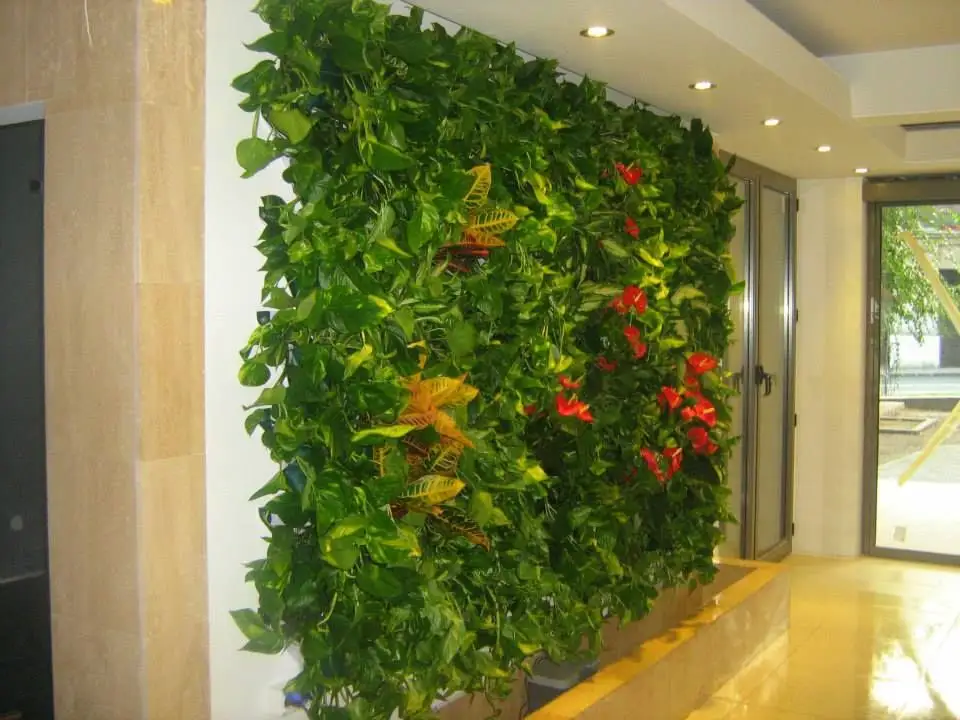
Living Walls: The Perfect Solution for Harmonizing Nature with Urban Space
We live in an increasingly polluted world saturated with artificial products, where green spaces have become an ever-growing problem due to the constant reduction of space allocated for them.
We live in a world increasingly suffocated by pollution and artificial products. Green spaces have become an ever-increasing problem because the space needed for them has been constantly reduced. What would be the solution in this case? Vertical gardens! These are "beds" of greenery placed on the surface of an interior or exterior wall.
Every portion of greenery brings a benefit to those who live or work near it, and research in the field has proven that one square meter of vertical garden produces the oxygen a person needs in a year.
The visual effects that a vertical garden can offer can be extremely spectacular thanks to the variety of plants used. In addition to the aesthetic benefit, it beautifies the landscape and rests the viewer's eye.
Casa's Story turned to Daniela Hantea, marketing manager at greenwalls.ro, to find out more about vertical gardens, what their advantages are, and what the steps would be for installing a vertical garden.
When did you start this business with vertical gardens?
Green Walls started its activity in 2011, out of the desire to bring nature closer to the urban landscape where, willingly or unwillingly, we spend most of our time.
Vertical gardens are for us the perfect solution for harmonizing nature with the urban space, contributing to the improvement of the environment and air quality, through the absorption of carbon dioxide and the release of oxygen, but also through the retention of dust particles and pollutants.
Places where the installation of a classic garden seemed impossible can be valued by arranging plants vertically. Practically, vertical gardens take over the advantages of green spaces and transfer them to urban environments where vegetation has never been a strong point.
We could list all the advantages of green spaces, from reducing sudden temperature variations to regulating atmospheric humidity to reducing unpleasant odors and noise pollution, but the truth is that the short answer to the question "why did we start this business" is: because we love plants and the spectacular effect they create.
Where did the idea of vertical gardens originate in the world?
The idea of vertical gardens is not a new concept. They have existed since ancient times, and the "Hanging Gardens of Babylon" are one of the seven wonders of the world, the perfect example.
In more recent times, French botanist Patrick Blanc, nicknamed "The Green Man," is considered the inventor of modern vertical gardens (Mur Végétal).
Even though American professor Stanley Hart White patented the first vertical garden in the 1930s, about 50 years before Patrick Blanc, the name of the French botanist will remain linked to the history of vertical gardens for his success in modernizing and popularizing the idea of vertical gardens, as well as for creating systems of vertical gardens and installing them all over the world.
What types of projects do your Romanian clients request?
Our clients' projects vary from case to case, depending on the space they want to landscape, but also depending on their imagination or that of the architects who help them in the design.
We receive requests for both classic vertical gardens, if we can call them that, and for vegetable paintings of different sizes or mobile panels for exhibitions and various social events. Another request is for vertical gardens made of forest moss.
As clients become more informed about vertical gardens, projects become more creative and interesting.
How interested are Romanians in such types of landscaping?
The segment of living walls represents a relatively new market in Romania, which creates both advantages and disadvantages. An advantage would be that the novelty element attracts the attention of potential customers, while the disadvantage is that it is not a concept known to the general public and we still need to work on this aspect.
As more information and professional solutions emerge, interest in living wall installations grows, especially in large cities where green spaces are limited.
What are the most commonly used plant varieties for living walls?
Plants must be chosen carefully, depending on several factors such as the brightness of the space, temperature, and the final color scheme of the living wall.
There are a number of plants recommended for living walls precisely because they are easy to maintain and can withstand various temperature and light conditions. For example: Scindapsus, Croton, Aglaonema, Anthurium, Spathiphyllum or Cordyline.
What are the trends in the field?
The trend is clearly upward; more and more companies from diverse fields of activity are considering installing a living wall, and recently they have started to be sought after for events such as fairs and exhibitions, but also for homes, which is an encouraging thing not only for those who install living walls, but also for plant producers and distributors.
How do you maintain a living wall?
Maintaining a living wall means, in fact, maintaining the plants. It is important that they are watered on time and checked periodically to avoid their getting sick.
One of the most common mistakes in plant care is overwatering or underwatering them. Especially when living walls are installed in business spaces (offices, conference rooms, receptions, etc.), it happens that the plants are not watered on time, which leads to their replacement.
A solution to avoid this mistake is to include programmed irrigation systems so that the plants are watered when and as much as needed.
We are also in the process of testing the Smart Garden principle, which will automate maintenance. This concept will mean, among other things, digital (computerized) control of plant photosynthesis lighting, humidity sensors, and fertilization.
Have you had projects for people who wanted to install a living wall in their home or on their balcony?
Yes, but the percentage of these projects is much smaller compared to the corporate sector. Usually, for homes, customers choose smaller-sized plant pictures.
If we wanted to set up a vertical garden, what advice would you give us?
Avoid installing living walls in areas where the sun shines directly on the plants throughout the day, as they risk being scorched by the sun, or in areas with large temperature fluctuations.
In indoor spaces, the exact location of the living wall should be determined together with a specialist to check if the microclimate is suitable for installing a living wall.
It is also important that when choosing the plants that make up the living wall, you also consider the recommendations of a specialist who has previously analyzed the space where you want to place the living wall.
What steps need to be taken to install a living wall?
The first step in setting up a living wall is to visit the space where you want to install it and consult regarding the location, analyze the microclimate (temperature, humidity), as well as other factors, such as the brightness of the space, which can influence the plants.
Following are the measurements, choosing the right plant species for the respective wall, taking into account both aesthetic criteria and specific physical conditions. After establishing the need for plants and vertical systems for their support, we can move on to the next step: the actual installation.
Vertical walls are installed using modular container systems made of an impermeable material that allows water to be distributed evenly and ensures waterproofing.
After installing the system, soil and the previously selected plants are added according to microclimate and design. The last step, but just as important, is the maintenance of the green wall, which we mentioned earlier.
We live in a world increasingly suffocated by pollution and artificial products, and oases of greenery have become an increasingly acute problem because the space needed for them has been constantly reduced. What would be the solution in this case? Green walls! These are vegetable beds placed on the surface of an interior or exterior wall.
Every patch of greenery brings a benefit to those who live or work there, and research in the field has proven that one square meter of green wall produces the oxygen a person needs in a year.
The visual effects offered by a green wall can be extremely spectacular thanks to the variety of plants used; it beautifies the landscape and rests the viewer's eye.
Green walls are for us the perfect solution for harmonizing nature with the urban space, contributing to the improvement of the environment and air quality through the absorption of carbon dioxide and the release of oxygen, but also by retaining dust particles and pollutants.
Places where the installation of a classic garden seemed impossible can be valued by arranging plants vertically. In practice, green walls take advantage of green spaces and transfer them to urban environments where vegetation has never been a strong point.
The idea of vertical gardens is not a new concept. They have existed since ancient times, and the "Gardens of Semiramis" or the "Hanging Gardens of Babylon," one of the seven wonders of the world, are the perfect example.
More recently, French botanist Patrick Blanc, nicknamed “The Green Man,” is considered the inventor of modern vertical gardens (Mur Végétal).
Even though American professor Stanley Hart White patented the first green wall in the 1930s, about 50 years before Patrick Blanc, the name of the French botanist will remain linked to the history of green walls for his success in modernizing and popularizing the idea of vertical gardens, as well as for creating vertical wall systems and landscaping them.
Setting up green walls represents a relatively new market segment in Romania, which creates both advantages and disadvantages. An advantage would be that the novelty element attracts the attention of potential customers, while the disadvantage is that it is not a concept known to the general public and this is something we still need to work on.
As more information and professional solutions emerge, interest in setting up living walls also grows, especially in large cities where green spaces are limited.
Plants must be chosen carefully based on several factors such as the brightness of the space, temperature, and the final color scheme of the green wall. There is a range of plants recommended for green walls precisely because they are easy to maintain and withstand various temperature and light conditions.
For example: Scindapsus, Croton, Aglaonema, Anthurium, Spathiphyllum or Cordyline.
Maintaining a green wall means, in fact, maintaining the plants. It is important for them to be watered on time and checked periodically to avoid disease. One of the most common mistakes in plant maintenance is overwatering or underwatering them.
Especially when green walls are installed in business spaces (offices, conference rooms, receptions, etc.), it happens that the plants are not watered on time, which leads to their replacement.
Avoid installing green walls in areas where the sun shines directly on the plants throughout the day as they risk being burned by the sun, or in areas with large temperature fluctuations.
In indoor spaces, the exact location where the green wall will be installed must be determined together with a specialist to check if the microclimate is suitable for installing a green wall.
Also, it is important that when choosing the plants that make up the living wall, you also consider the recommendations of a specialist who has previously analyzed the space where you want to install the green wall.
The first step in creating a living wall involves visiting the space where you want to create it and consulting about the location, analyzing the microclimate (temperature, humidity), as well as other factors, such as the brightness of the space, which can influence the plants.
Measurements are followed by the selection of plant species suitable for the respective wall, taking into account both aesthetic criteria and specific physical conditions. After establishing the need for plants and vertical systems to support them, you can move on to the next step, the actual installation.
Green walls are installed using modular container systems made from an impermeable material that allows water to be distributed evenly and ensures waterproofing. After installing the system, add the soil and the previously selected plants according to the microclimate and design.
The last step, but just as important, consists of maintaining the green wall, which we mentioned earlier.