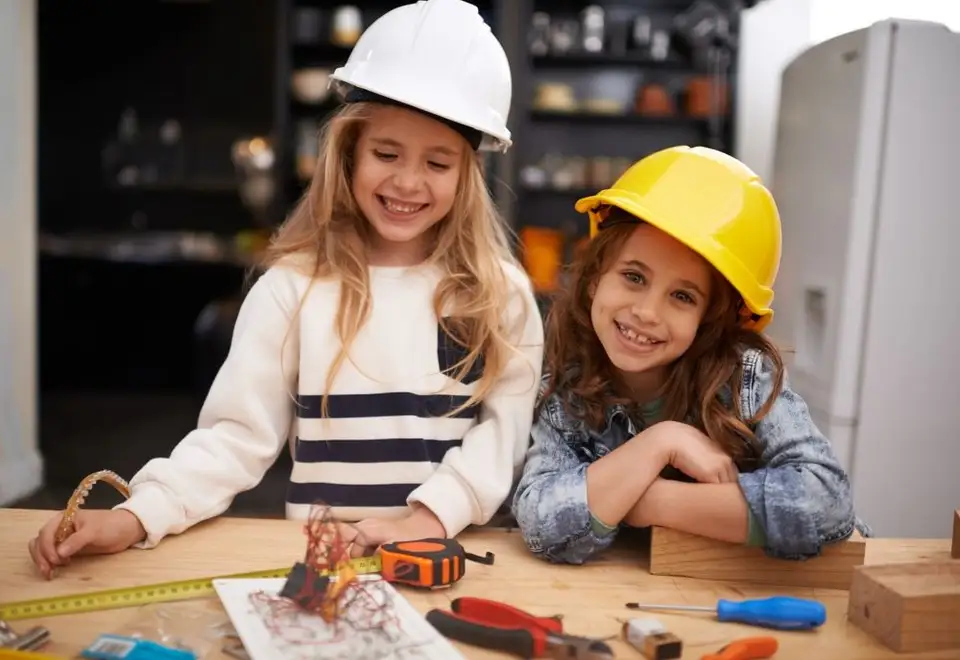
Budding little inventors. There's a question that parents often overlook, but which deserves all their attention: What truly fascinates my child when they play?
Not what toy they have in their hand, but what they do with it.
If the answer is "builds," "arranges," "takes apart to see how it works," or "wants to make a house bigger than yesterday's" – you might have a future architect, engineer, designer, or urban planner on your hands. But more importantly, you have a child who needs the right stimuli.
What science says about play and vocation
Specialists highlight that early involvement in construction activities promotes the rapid formation of neural connections that support advanced reasoning. In other words, a child who builds regularly isn't just exercising their dexterity; they are literally building their brain.
STEM education combines science, technology, engineering, and mathematics to prepare children for an increasingly technological world, with benefits ranging from developing critical thinking and creativity to improving problem-solving skills.
The figures that support this direction are clear. According to reports by the European Commission, by 2030, over 85% of new jobs will require digital, technical, or engineering skills – precisely the abilities developed by a child accustomed to spatial thinking, planning, and practical construction.
In Romania, interest in STEM has increased by 40% among high school students in the last five years, according to data from the Ministry of Education, a sign that a new generation is beginning to understand where their professional future lies.
But these paths don't take shape at age 14, when choosing a profile. They take shape at 6, 8, 10 years old, in the room, on the rug, with a construction set in hand.
Architecture is not just a profession. It's a way of looking at the world.
It's not simple. And that's precisely why it's valuable.
Children who frequently use building toys become more intellectually independent and show increased perseverance when faced with unknown obstacles. Interactive activities strengthen their personal initiative and natural desire to explore.
There is also a cultural dimension that cannot be ignored. Architecture is collective memory. The old houses in the center of Brașov, the wooden bell towers in Maramureș, the Art Deco facades in Bucharest – all are stories built in stone, wood, and brick. A child who learns to "read a building," to understand that it has a style, an era, a logic, becomes an adult more attentive to the world they live in.
Kid Do Ro: when the model becomes a life lesson
Concretely, this means that: