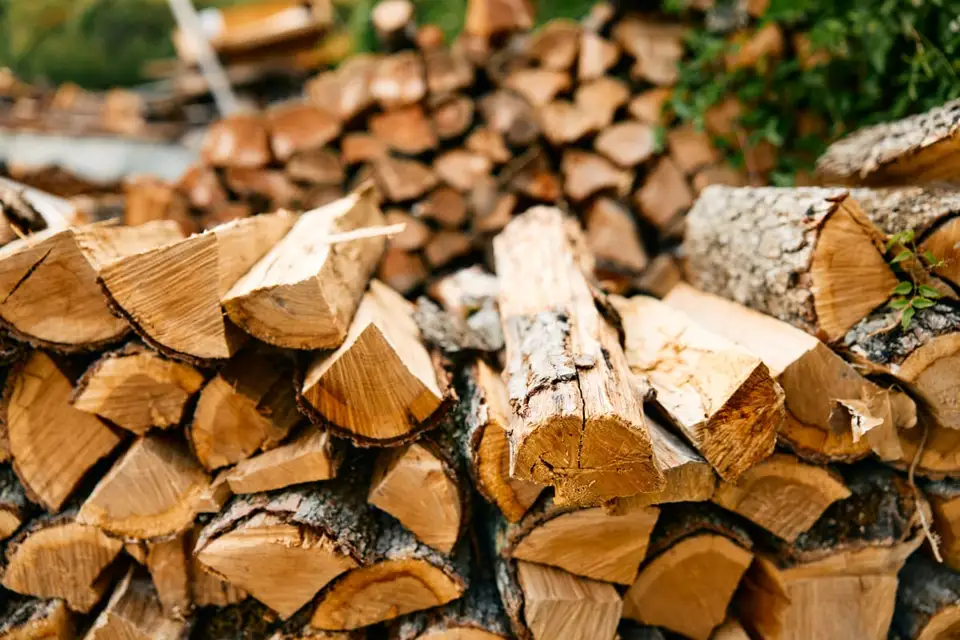
Beech is the wood that gives you that settled fire, with a stable flame and lasting embers. When you're looking for constant heat, density matters, and beech has a compact structure, over 700 kg/m³, which burns slowly and evenly. The result is immediate: you feed your stove or fireplace less often and maintain the temperature better, without sudden peaks and drops.
Clean burning also comes from the low resin content. Beech produces fewer aggressive sparks, less smoke, and leaves smaller deposits, which is noticeable in chimney maintenance.
In terms of efficiency, we're talking about a calorific power of around 4.2 k Wh/kg, enough to feel that every piece does its job. If the wood is dried correctly, under 20% moisture, burning becomes predictable and efficient.
Therefore, beech logs are sought after for both heating homes and cabins, as well as in Ho Re Ca, for bread or pizza ovens where you need constant temperature and clean embers. When the ash remains minimal, under 1%, cleaning is no longer a chore.
In practice, the difference is felt with every fueling: the firebox stays clean, the fireplace glass stains less easily, and the heat distributes evenly for hours on end, without surprises, on cold nights.
What makes beech so suitable for constant fire?
The calorific power of around 4.2 k Wh/kg translates simply: you get a lot of heat from a reasonable amount of wood. When you have a fireplace or stove that works well on embers, beech logs become the perfect ally for long evenings with stable temperature. In cabins or tourist spaces, this very stability makes the difference between heat and comfort.
There's another aspect that many ignore: how uniform the wood is as an essence. Beech has a relatively homogeneous structure, so similar pieces burn predictably without surprises. This helps a lot when you want to adjust the draft and keep the fire in an efficiency zone, not smoke.
To make it easy to apply, here's what constant fire looks like in everyday life when using beech logs:
you put wood on the fire less often because the embers last;
you maintain a more stable temperature in the room;
you use a smaller draft with fewer losses up the chimney;
you enjoy a calm flame without frequent crackling.
When looking for firewood, beech deserves to be your first option if your goal is long-lasting heating, not just a quick ignition for 20 minutes.
Clean burning: little smoke, fine ash, rarer deposits
Another practical benchmark is the percentage of ash. If you're left with little ash (around under 1%), it means the wood has burned efficiently and hasn't been wasted on residues. Cleaning the firebox becomes faster, and the airflow remains better, which further supports complete combustion.