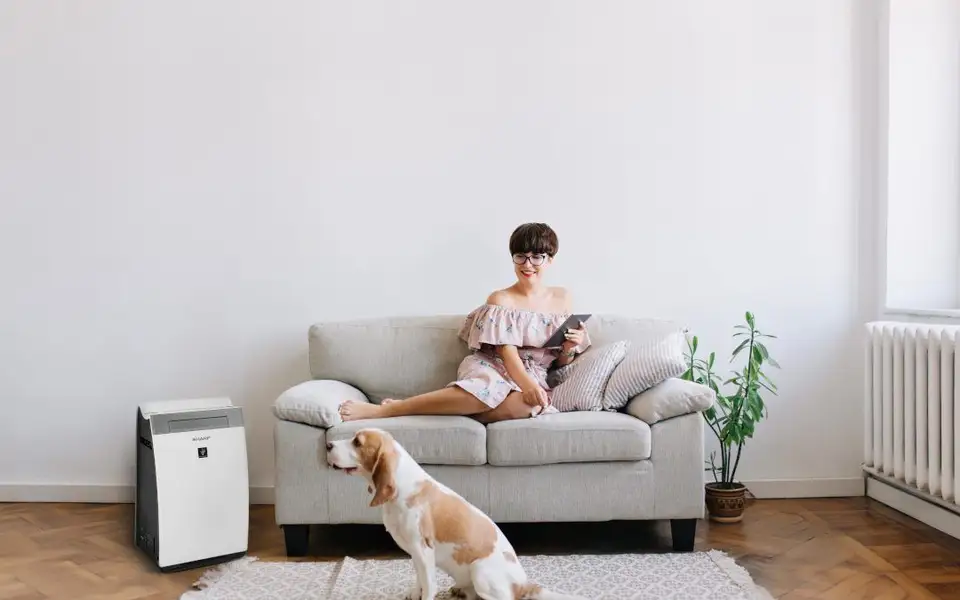
The Environmental Protection Agency states that when it comes to pollutants, their concentration indoors can be up to five times higher than outdoors.
Pollutants are found in cigarette smoke, cooking fumes, gases from cleaning or construction products, and if you have pets, they may also contribute to an unhealthy indoor environment.
All these pollutants (sometimes without us realizing it) found inside our homes can cause certain health problems such as nasal, throat or eye irritation, headaches, nausea or various liver, kidney or nervous system disorders.
In these conditions, does the air purifier become a necessity for a healthier indoor environment or is it just a fad?
What we can say for sure is that these air purifiers are not just a fad, they have real benefits on the environment in which we live and our health, and for many people, the air purifier has even become a necessity.
This technology initially appeared in the industrial environment, but gradually it was introduced into people's daily lives and homes to ensure increased comfort.
How does an air purifier work?
HEPA filter: retains very small particles (dust, allergens, mold, bacteria).
Activated carbon filter: retains gases or various odors, such as cigarette smoke, cooked food, chemicals or paints.
Ionization: emits negative ions to retain dust particles, allergens, cigarette smoke or mold.
Ultraviolet light: the only way to kill bacteria and viruses in the air
It is said that the best air purifiers are those that use activated carbon and HEPA filters, but in reality, the best air purifier is the one that ensures a healthy indoor environment for your home.
Before choosing an air purifier based solely on popular opinion, it would be good to think about the problems you face and the solutions you have from this point of view.
These purifiers use ultraviolet light to eliminate viruses, bacteria or various harmful pathogens. The idea of such an air purifier originated in hospitals, where special UV lamps are used to disinfect wards and laboratories. UV light acts on pathogens by breaking the molecular bonds in their DNA.
Studies have shown that these purifiers kill approximately 99.9% of mold spores, germs and other bacteria that could affect health.
HEPA filter air purifiers
One of the most well-known air purifiers is the one with a HEPA filter, which has the ability to remove 99.7% of particles larger than 0.2 microns from the air in your home. An air purifier with a HEPA filter is extremely efficient at removing particles such as pollen, mold or dust.
One of the disadvantages of this type of filter is that it cannot retain microorganisms such as germs, viruses or bacteria, but it will certainly bring an improvement to the air quality in your home.
Air purifiers with activated carbon
Air purifiers with activated carbon are efficient in removing smoke, odors, vapors and gases found in the air of your home. People who are sensitive to smells can opt for such a purifier to get rid of this problem.
Unfortunately, an air purifier with activated carbon is less effective in removing pollen particles, dust or mold from the air. There are also models of purifiers on the market that include a HEPA air filter in addition to the activated carbon filter.
Ionization air purifiers are the quietest because they work without a motor, unlike other purifiers. This type of purifier emits negative ions into the air which bind to particles charged with positive ions such as dust, eliminating them. An ionization air purifier can remove dust, allergens, viruses, bacteria, smoke, but not odors.
Another criterion by which air purifiers can be classified is the mode of use or, more precisely, the area they act on. There are portable purifiers of small size that you can easily move from one room to another as needed.
Such a portable purifier works with a HEPA filter and helps you get rid of dust or pollen particles in the air, being ideal, especially for allergy sufferers. The price of a portable purifier is affordable for everyone, and the benefits it brings are more than significant compared to the price.
On the other hand, there are also air purifiers that are integrated into the air conditioning or heating system, purifying the air in the entire dwelling, not just one room. Of course, such a system is much more expensive than a portable purifier, but it can bring an improvement in quality of life, especially for people who suffer from severe allergies or asthma.
We can also differentiate between traditional air purifiers that work automatically and those that have smart connectivity and can be controlled remotely using a smartphone or tablet. The latter are much more performant and have a price accordingly.
What are the effects of an air purifier on our health?
Reduces the frequency of asthma attacks: inside the dwelling there can be many triggers for asthma attacks: from dust to various particles that come from household cleaning products, cosmetics or paint-based products. If chosen properly, such a purifier can successfully remove these triggers, reducing the frequency of asthma attacks.
In such a situation, the air purifier is no longer just a whim, but a necessity.
Eliminates allergens: dust or pollen are not only triggers for asthma but also for allergies. If you eliminate potential allergens from your home, you will enjoy a healthier environment and forget about the allergies that were causing you problems.
Retains tobacco odor and prevents certain health problems: It is no secret that passive smoking or inhaling cigarette smoke can lead to the development of certain lung conditions. Air purifiers that work with a HEPA filter or activated carbon help remove cigarette smoke from the air and maintain good health.
Traps radon gas: numerous studies have shown that certain gases, such as radon, can contribute to the development of lung cancer. Radon gas can also be found in homes because it can enter through various cracks in floors/walls or through gaps around pipes or electrical wires. An air purifier can help remove radon gas from your home.
Of course, there is no need to panic because the gas must be present in a fairly large quantity to have a negative effect on health.
Reduce carbon dioxide levels in your home: when the amount of carbon dioxide in your home is too high, you may experience headaches, dizziness, nausea, or drowsiness. An air purifier with a HEPA filter helps reduce carbon dioxide levels and get rid of these problems.
Improves mood: you've probably noticed that when you breathe clean air, your mood and disposition improve significantly. Ionization purifiers help a lot in this regard, increasing your good mood and protecting you from episodes of sadness or even depression.
Reduces stress: it has been proven that pollutants in the air have a negative effect on relaxation and cortisol levels in the body. Air purification helps remove stress and increase productivity while helping you relax at the same time.
What not to expect from an air purifier?
Another myth circulating when it comes to air purifiers is that they have the ability to cure flu and colds. This is partially true because such a device with ionization helps retain germs and viruses and prevent certain health problems, but an air purifier is not the solution for treating flu and colds.
As we mentioned earlier, the air purifier is your best friend in preventing conditions and maintaining optimal health.
How to choose an air purifier?
Don't forget that an air purifier needs proper maintenance, which also means maintenance costs, namely the regular replacement of filters (high-quality HEPA filters can be replaced even once every five years, activated carbon filters are recommended to be replaced once every six months, and pre-filters once every three months).
Take this into account when choosing an air purifier for your home to see exactly what the extra costs are, in addition to the purchase price.
After you have reduced the number of options, you can use the price or recommendations from people who have already used it as a tiebreaker criterion to make the best decision.