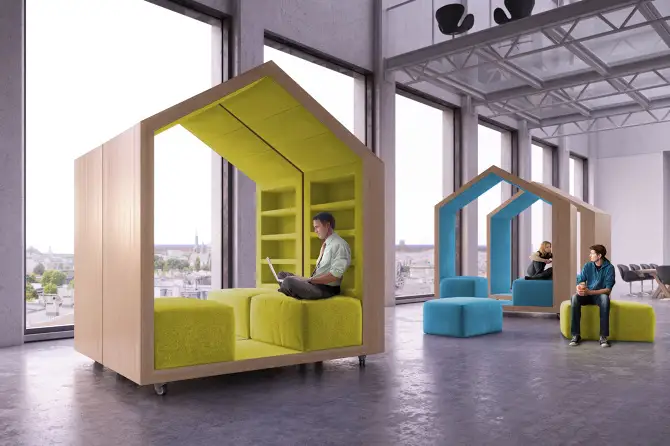
In the traditional view, when people thought about their homes, they had an almost mathematical conception. A sofa + a television = 1 living room. A bed + 1 wardrobe = a bedroom.
However, in a context of ongoing global urbanization, where people have an increasingly smaller habitat (it is predicted that by 2017, the majority of people will live in very narrow urban areas), the perception of living spaces is becoming more and more fluid. Marcus Engman, Head of design for IKEA, estimates that the future of furniture objects will be increasingly versatile.
Let's take the sofa as an example. In the past, it was the central piece of the living room and therefore the house. Now, it is no longer just a space for socializing. People eat on the sofa in small apartments and also use it for sleeping. Directing it towards the television is no longer mandatory, in a world obsessed with wireless and gadgets.
The trend extends to other areas of the house as well, with small spaces forcing objects to become multifunctional pieces where you can work, eat, socialize and play.
Furniture will therefore become increasingly versatile, forced to adapt to new ways of living. “It is possible that in the future the chair will become the central piece of a dwelling because it can serve so many things,” estimates Marcus Engman. The chair can be used as a bedside table, a seat, an extension of the table or a ladder.
In addition, chairs can be designed to be easily stored inside each other when not in use.
Storage will also not remain the same. People are beginning to understand that the urban environment is not suitable for massive wardrobes and generous storage spaces. Moreover, many of the things that were physically stored in the past (music, films, books) are now digitized. Homes will become airier and the few things that are stored will likely be carefully displayed.
IKEA has already accustomed us to compact packaging and will continue on the same line - according to the aforementioned design manager, there is no point in delivering air around the world, it would be an unsustainable attitude and would increase the price of the final product. We can therefore expect the Swedes and their competitors to pack furniture elements into increasingly compact packages.
Another direction for furniture products is tactility - extending touch screen gadgets that we have incorporated into our daily lives. Materials will keep pace with technological developments and will no longer be limited to the visual. The tactile component will become increasingly important in choosing objects for the home.