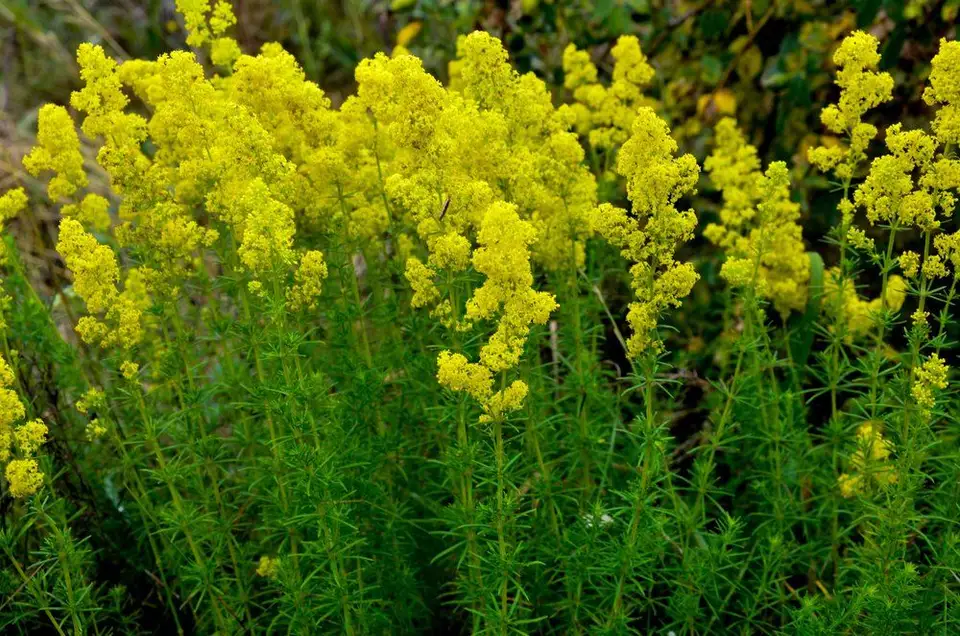
Meadowsweet, with its delicate beauty and an unmistakable fragrance reminiscent of linden but with finer and slightly menthol notes, are rightfully considered magical flowers. Although they belong to the spontaneous flora and are not traditionally cultivated, these wonders of nature can bring an explosion of color and fragrance to any garden.
It is said that meadowsweet gathers the entire strength of the summer sun, bestowing it upon those who contemplate them. A single stem, with its hundreds of tiny flowers, can perfume an entire room. Carefully harvested so as not to uproot their shallow root system, bouquets of meadowsweet are particularly decorative, and their fragrance persists even after drying, transforming them into a natural air freshener for the home.
Classification and main varieties
Meadowsweet, known scientifically as Galium verum and bearing popular names such as Drăgaică, Frumoasele, Zânele, Închegătoare, Sanjuane or Floarea Sfântului Ion, are perennial herbaceous plants from the Rubiaceae family.
Widespread primarily in Europe but also in regions of Asia and North Africa, meadowsweet is prized both for its enchanting appearance and its medicinal virtues and role in popular traditions.
Their flowering period extends from July to September, but the chromatic and olfactory spectacle peaks from mid-June to late July. The genus Galium comprises approximately 400 species, some of which are particularly widespread:
Yellow meadowsweet (Galium verum): The most well-known variety, with yellow-gold flowers, extensively used for medicinal purposes.
Woodruff (Galium odoratum): Also known as sweet woodruff or asperula, it has white flowers and a distinct sweet aroma.
White meadowsweet (Galium mollugo): With white flowers, just as fragrant as the yellow variety, often growing in the same areas.
These plants spontaneously appear in lowland areas, along roadsides, in meadows, on hillsides and in forest clearings, preferring well-drained soils and exposure to sun or partial shade.
Distinctive features
The stem of meadowsweet is slender, capable of reaching heights of up to one meter. It is adorned with small, yellow-gold (in Galium verum) flowers arranged in delicate clusters reminiscent of a rain of stars. Each flower has four petals, a detail that, according to popular belief, symbolizes a divine blessing. The leaves are very narrow, pointed and slightly downy on the underside.
In striking contrast to its sweet and intoxicating scent, the plant's taste is intensely bitter, an indication of its remarkable tonic and purifying properties.
Meadowsweet in legends and folklore
Perennial and wild meadowsweet flowers bloom year after year at the end of June, regardless of the weather's whims. It is said that on Midsummer Eve (June 23rd to 24th), fairies dance around them, bestowing magical powers upon them. Their flowering is closely linked to the intense sunlight of the long summer days.