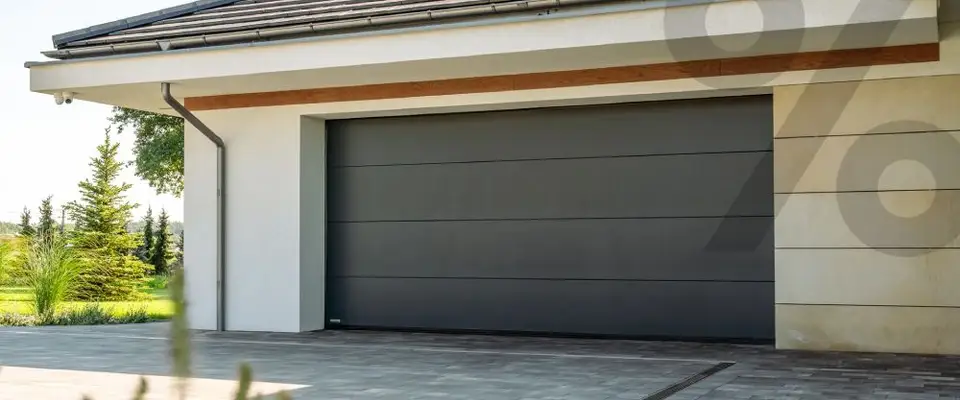
In the last decade, “usi de garaj” has become one of the most sought-after expressions in the sphere of residential construction in Romania.
The engine of change is not only driven by the real estate boom or the natural need for security, but also by the fact that the garage has ceased to be a mere shelter for the car: it has become a workspace, a bicycle storage area, a fitness room, or a DIY workshop.
This is where the door comes into play, an apparently banal element, but one that dictates the indoor temperature, the cost of bills, the level of noise penetrating from the street, and, last but not least, the safety of the family.
Until recently, Romanians bought garage doors in the same way they chose a radiator: they went to the nearest DIY store, asked for the standard size, and let themselves be convinced by the lowest price. The result? Undersized systems, uncalibrated springs for the actual weight of the panels, and costly repairs after only a few seasons of freeze-thaw cycles.
Our reporters spoke with service engineers, architects, and affected homeowners to find out why choosing the supplier and, above all, the installation team is crucial to the fate of any garage door.
The first conclusion of the investigation: the brochure material is not always a mirror image of the delivered product. In catalogs, all sheet metal panels appear impeccable, each gasket promises absolute sealing, and torsion springs are described as "tested for 25,000 cycles".
In reality, the difference between a premium door and an entry-level one is not visible at first lift, but after a few hundred operations when thermal insulation begins to fail, the lacquer fades, and washers vibrate when a truck passes on the road in front.
The second conclusion: a competent supplier refuses to sell "from universal stock". Engineer Andrei S., specialist of a German brand present in Romania for twenty years, explains: “With sectional doors, each opening requires a separate calculation of springs, sliding rails, and motor.”
If the garage has a beam 15 centimeters above the opening, and you install the set designed for 30 centimeters, you will break the mechanism." Customers tempted by online promotions often ignore the warning and order dimensions "close enough", hoping that the installer will "adjust" the situation on site. In practice, artisanal adaptation halves the lifespan of the system.
The third conclusion: the strength of any brand lies in its network of authorized installers. A perfectly calibrated kit can be irremediably compromised by an untrained team with unsuitable tools or a tight schedule.
Marius P., an entrepreneur from Brasov, tells the story of how he purchased a sectional door with 40 mm thick panels and a panoramic acrylic glass panel, the delivery being impeccable. "I chose the cheapest installation on the market. The guys cut the rail with a grinder directly on the pavement, they lacked chemical anchor bolts, and within three months the door was rattling with every gust of wind.